Sarah Whitehead webinar today

Beanwood

Administrator
That looks really interesting @Joy, I have signed myself for the free webinar. :)

I am seeing some interesting behaviours at the moment...and I not quite sure the bows I am seeing are necessarily linked to a desire or invitation to "play"
 
  • Like
Reactions: Joy

Boogie

Moderator
Location
Manchester UK
Fascinating. Very good point about checking for context.

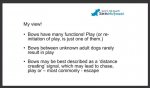
Here is her summary, I agree with her. I didn’t know about the greeting stretch. I have always given Tatze space to stretch before the puppy bounds in - looks like I’ve been giving her space to greet me, which really pleases me :)

07BE8ECE-D483-4BF6-B904-8D9DE281626A.jpeg
 
  • Like
Reactions: HAH
I thought it was a little underwhelming.
Do people really mistake a stretch with a play bow? I very much doubt that's a common thing. I suppose it might be easy enough to mistake it in a still picture, but the energy is so different in motion that I'm not sure she was arguing against anything real for that first section.

The part about creating distance was a bit more interesting, but certainly for most interactions I see, a play bow (yup, still going to call it that ;) ) is an invitation to chase, which I include in "play" when it's consensual between all parties. Even watching the video of the bowing in the interaction between her collie and the GR, I would consider that very much a game, even though there was no contact between them and only occurred in brief spurts.

I do think it can be easier to mistake it with a herding dog stalk, for those collies who throw themselves onto the ground with a lot of energy, but even so, the eyes and tail generally give it away. There's a very different intensity between the loose and floppy body language of a dog who is wanting to interact and one who is in a prey sequence.

There is one other type of movement which I have seen which might come under the same heading, and that's a stiff-legged "bow", where the dog stays quite upright and stiff when they're doing it. It's akin to a person taking a fast and heavy stomp forwards to scare off a critter. Again, the body language is very different and, whilst some of the mechanics are the same, no-one would ever confuse one for the other.

A play bow is a bow. There are other types of bow. It doesn't mean we shouldn't still call a play bow by that name. As she said earlier on, we have different words for "smile" to differentiate between something friendly and a smirk. To call them all just a "smile" would be to withhold information. So surely by the same note, calling a play bow just a bow means we're doing just that, withholding information. If we're sure it's an invitation to play, whatever form that play might take, then why not call a spade a shovel?
 

Joy

Location
East Sussex
I agree the stretch is completely different from a bow. Also I guessed the retriever was doing a trained bow from the still photo, so I think a play bow or escape bow both have muscles more tensed for movement.

I'm not quite sure what I think. Molly rarely chooses to play with other dogs (she's not aggressive, just not interested) but occasionally if a dog comes right up at speed and invades our space she will do a play bow and then take off running in big circles. I've always thought she was inviting the chase, but now I'm not so sure. She very rarely chases the other dog back and it usually ends with her coming to sit very close to me - at which point I turn and walk away with her. So maybe in this case the bow is a way of escaping/ creating space.

I liked that the webinar prompted me not to take a dog's feelings for granted.
 

HAH

Moderator
Location
Devon, UK
I thought it was a little underwhelming
I agree - I think I was hoping for more 'insight' and perhaps some better research foundations for bow behaviours as she was presenting it.

I got the feeling that the whole "don't say play, just say bow" set-up was a bit of an awkward and unecessary device for her to talk about what she was really interested in, which was the different types of bows, stretches and dips. That bit I found interesting because I'm pretty new to it all, so like @Boogie I particularly loved hearing about the greeting stretch. This is what Kipper does every morning, working through a lovely routine stretching out his limbs - and I guess saying 'good morning' with it :giggle:

So in summary, agree with @snowbunny that in my mind at least, a play bow is exactly that - and anything else is either a bow, or a stretch, or a test, or a bounce etc. I liked the emphasis on how much we slow-eyed hoomans miss, but it also got me thinking that this is all a bit one-dimensional; there are so many other elements to dog interaction with scent, sounds, environment, human presence etc. etc. that I'm not sure it's helpful to isolate single behaviours in this way. Certainly sparked a lot of thoughts though, which is never a bad thing!
 
I haven't watched the webinar, but have certainly come across different types of "bow".

There's certainly a big difference from the bouncy fun, "let's play" bow to the Collie who lies down alert and the silly young Dalmatian who bows down stiffly then springs forward, jumps on Homer's back biting him. Homer and I have both become cautious of the last two types.

My Airdale I had as a child would play bow to engage in games of bounce with me. Even when she was really old and I only came home once a year she'd play little bouncing games with me. Homer will get up from lying calmly and stretch indicating that its time for a walk, he doesn't bow down to anyone.
 

Beanwood

Administrator
Like @HAH I was hoping for a bit more insight or information. I had never thought the "bow" necessarily was an invite to play, although I think sometimes it is. I have seen the play bow used in various context, and indeed with Bramble, it often means... "Go away! Can't you see I am busy?" Pretty sure the other dog sees her bow as just that too. Her body stance is usually tense and ready to spring forward.

The webinar was free, and it was thought-provoking. I, Of course, being free meant that it was also a vehicle to promote another product, a more in-depth look at canine communication. Whilst I liked her tone, pace and manner, very easy to listen too, I would need to be sure her courses were balanced enough, ie: a good objective review of all the evidence out there. There were some teasers at the end, covering the content of the discounted course, which did look interesting.
 
Top