- Location
- Monmouthshire, Wales
In the books I describe the routes using maps and text. Maps give the reader the opportunity to visualise the route and where they are, while the text gives the detail.
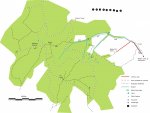
There are many different types of map, from simple route diagrams to maps that show the whole area in which the walk is located. Route diagrams are fairly easy to produce as they just show the path as a line, noting the features encountered along the way. Area maps take a lot more work to produce than route diagrams as every path and feature in the area needs to be mapped and accurately placed. The advantage of area maps is that they give the walker the opportunity to vary the route if necessary, for example if a path is closed for forestry work.
I decided that an area map would be the most useful format for the books. There were no useful maps that I could adapt. Ordnance Survey maps are copyright and the OpenStreetMap project, while free, would leave me with no control over content. Creating an area map required that I surveyed the areas and drew the maps myself. It would take longer but the resulting map would be tailored to the needs of the books.
Surveying the area and making maps was the longest, but most enjoyable, phase of writing the books. It needed lots of dog walks. Sometimes we got lost as paths had been moved or overgrown, sometimes we found unmarked paths to be explored. Holly loved it when the path disappeared and we had to go ‘off piste’. She showed a real talent for finding and following deer tracks through the undergrowth and getting us out of trouble.
The GPS app on my smartphone (A-GPS Tracker) made it fairly easy to record every walk. I’d just start recording at the car, walk the route, and stop recording when we’d finished. At the end of the walk I saved the track as a .GPX file and, when we got home, copy it to my PC. GPX files can be read straight into Google Earth (tools – GPS – import from file), producing an overlay on the terrain. After a few visits to an area I had a series of files that showed all the paths and tracks, just like the one below.
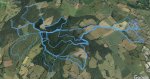
This shows a series of walks from our house, on the right, along Offa’s Dyke Path to Kingswood. It’s an area I plan to add to the new Gwent book. The blue lines cover about 34 miles of walking and show all the main paths through the woods. It’s easy to see the possibilities for circular walks.
Holly and I did surveys like this for every walk in each book, visiting each area several times to build up the network of paths. Walks were done in both summer and winter to check for muddy sections. The other day I added up all the GPS tracks; we walked over 1300 miles during the surveying phase of the two books.
Each walk was also an opportunity to take photos for the book. It’s no exaggeration that I took thousands of pictures for each book, and threw nearly all of them away. I found that the ones I kept tended to be the ones taken on sunny days. Spring and Autumn were particularly good times of year as the good light and colours provide interest. Surveying could be done in any weather but photography needed good light, so I started to plan walks around the weather forecast. If it looked like a nice day for photography I’d go to an area where I needed photos for the book.
All the surveying, mapping and photography took time. It took about a year to map the Wye and 18 months for the Forest of Dean.
In the next article I’ll start looking at methods for turning all this information into a map.
There are many different types of map, from simple route diagrams to maps that show the whole area in which the walk is located. Route diagrams are fairly easy to produce as they just show the path as a line, noting the features encountered along the way. Area maps take a lot more work to produce than route diagrams as every path and feature in the area needs to be mapped and accurately placed. The advantage of area maps is that they give the walker the opportunity to vary the route if necessary, for example if a path is closed for forestry work.
I decided that an area map would be the most useful format for the books. There were no useful maps that I could adapt. Ordnance Survey maps are copyright and the OpenStreetMap project, while free, would leave me with no control over content. Creating an area map required that I surveyed the areas and drew the maps myself. It would take longer but the resulting map would be tailored to the needs of the books.
Surveying the area and making maps was the longest, but most enjoyable, phase of writing the books. It needed lots of dog walks. Sometimes we got lost as paths had been moved or overgrown, sometimes we found unmarked paths to be explored. Holly loved it when the path disappeared and we had to go ‘off piste’. She showed a real talent for finding and following deer tracks through the undergrowth and getting us out of trouble.
The GPS app on my smartphone (A-GPS Tracker) made it fairly easy to record every walk. I’d just start recording at the car, walk the route, and stop recording when we’d finished. At the end of the walk I saved the track as a .GPX file and, when we got home, copy it to my PC. GPX files can be read straight into Google Earth (tools – GPS – import from file), producing an overlay on the terrain. After a few visits to an area I had a series of files that showed all the paths and tracks, just like the one below.
This shows a series of walks from our house, on the right, along Offa’s Dyke Path to Kingswood. It’s an area I plan to add to the new Gwent book. The blue lines cover about 34 miles of walking and show all the main paths through the woods. It’s easy to see the possibilities for circular walks.
Holly and I did surveys like this for every walk in each book, visiting each area several times to build up the network of paths. Walks were done in both summer and winter to check for muddy sections. The other day I added up all the GPS tracks; we walked over 1300 miles during the surveying phase of the two books.
Each walk was also an opportunity to take photos for the book. It’s no exaggeration that I took thousands of pictures for each book, and threw nearly all of them away. I found that the ones I kept tended to be the ones taken on sunny days. Spring and Autumn were particularly good times of year as the good light and colours provide interest. Surveying could be done in any weather but photography needed good light, so I started to plan walks around the weather forecast. If it looked like a nice day for photography I’d go to an area where I needed photos for the book.
All the surveying, mapping and photography took time. It took about a year to map the Wye and 18 months for the Forest of Dean.
In the next article I’ll start looking at methods for turning all this information into a map.